

A Complete Guide to Stainless Steel Fittings
Whether you’re specifying fittings for a new installation or sourcing replacements for an existing system, choosing the right stainless steel fittings involves more than just matching a thread size. Grade selection, fitting type, connection method and pressure rating are all important.
This guide covers the main types of stainless steel fittings, the grades most commonly used in commercial and industrial applications and the factors that matter most when choosing fittings.
Why Stainless Steel for Pipe Fittings?
Stainless steel is the default material for fittings in most sectors because its corrosion resistance and mechanical strength make it suitable for various applications.
Carbon steel fittings corrode when exposed to moisture, chemicals or saline environments which means they’re not suitable in a lot of sectors because of compliance and safety issues.
Stainless Steel Grades
Not all stainless steel is the same and the grade matters when it comes to pipe fittings. The two grades you’ll find most often are 304/304L and 316/316L.
Grade 304 and 304L
304 is the most widely used austenitic stainless steel grade. It contains approximately 18% chromium and 8–10% nickel, giving it good general corrosion resistance for most indoor, non-aggressive environments.
Grade 304L means a lower carbon content, which is more suitable for welded fittings or systems.
Grade 316 and 316L
316 has more chloride resistance, making it the standard choice for marine environments, chemical processing and food and beverage systems, as well as outdoor installations in coastal areas.
316L again indicates low carbon content, with the same weld-zone benefits as 304L. Most stainless steel fitting suppliers stock 316L as default because it’s suitable for all the same applications.
Types of Stainless Steel Fittings
Butt Weld Fittings
Butt weld fittings are joined by welding the fitting directly to the pipe, producing a smooth internal bore with no gaps or mechanical joints. This makes them the preferred choice in high-pressure systems, high-temperature applications like food processing, pharmaceutical and petrochemical.
Common butt weld fitting types include:
Elbows (45° and 90°) change the direction of flow. Long-radius elbows (with a centreline radius of 1.5× the pipe diameter) produce less turbulence and pressure drop than short-radius versions, and are standard in most process piping.
Tees branch the flow. Equal tees have the same bore throughout; reducing tees have a smaller branch outlet for splitting flow to a smaller-diameter line.
Reducers connect pipes of different diameters. Concentric reducers are centred on the pipe axis and are used in vertical pipework. Eccentric reducers keep one side of the pipe level, important in horizontal lines where you need to maintain a consistent invert level, or to prevent air pockets in pump suction lines.
Caps seal the end of a pipe. Stub ends are used with lap joint flanges to allow the flange to rotate freely, simplifying bolt alignment.
Socket Weld Fittings
Socket weld fittings have a recessed socket that the pipe inserts into before welding. The weld is made at the outside of the joint rather than a butt weld. They’re used in smaller bore sizes (typically up to DN50 / 2″ NB) and are rated for higher pressure than equivalent threaded fittings of the same size.
The internal socket creates a small crevice at the pipe end, which can be a concern in corrosive or hygienic applications. For this reason, socket weld fittings are generally not used in food, pharmaceutical, or high-purity water systems, where butt weld construction is preferred.
Low Pressure Threaded (BSP) Fittings
Threaded fittings use a mechanical thread connection rather than a welded joint. They’re faster to assemble and disassemble without specialist equipment, making them common in lower-pressure utility applications, instrumentation connections, and installations where components need to be regularly removed for maintenance.
The British Standard Pipe (BSP) thread system is the standard in the UK and much of the world outside North America. There are two variants:
BSPP (British Standard Pipe Parallel) — parallel threads that rely on a seating face or soft seal for the pressure-tight connection. The threads themselves don’t seal; the joint is made by a flat face, O-ring, or bonded seal washer. BSPP is used where a reliable, repeatable seal is needed without sealant, and is the standard for instrumentation and many plumbing applications.
BSPT (British Standard Pipe Tapered) — tapered threads that tighten progressively as the fitting is made up, forming the seal through thread interference. PTFE tape or thread sealant compound is typically used to fill the thread gaps. BSPT is used in general pipe fitting and is the standard thread form for most UK plumbing and gas fittings.
BSPP and BSPT are not interchangeable. The thread pitch and angle are identical (55° Whitworth form), so the threads will engage with each other, but a parallel thread in a tapered port won’t seal won’t go in properly, which can be a common source of leaks.
NPT (National Pipe Tapered) is the US equivalent of BSPT but uses a 60° thread angle and different pitch series. NPT and BSPT threads will not make up correctly together. See our [detailed comparison of BSPT, BSPP, and NPT threads] for a full explanation of the differences.
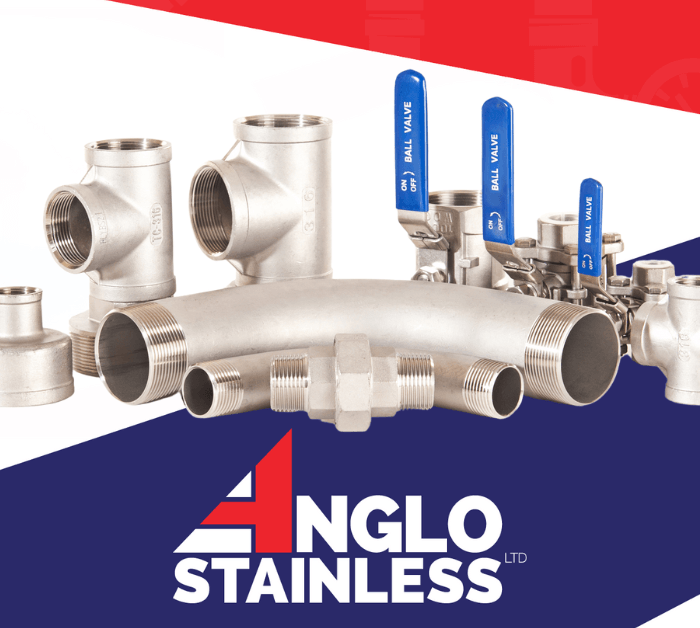
Common threaded fitting types include elbows, tees, couplings, reducing couplings, bushes, barrel nipples, hex nipples and unions.
Flanges
Flanges join pipe sections, valves, pumps and equipment using bolted connections. The advantage over welded or threaded joints is accessibility since a flanged joint can be unbolted and separated without cutting pipe or disturbing the system extensively.
The main flange types Anglo supply are:
Weld Neck Flanges (RFWN) have a long tapered hub that transitions gradually to the pipe wall thickness. The butt weld between flange and pipe is made on the hub, producing a strong, low-stress joint. Weld neck flanges are the premium choice for critical high-pressure and high-temperature applications.
Slip-On Flanges (RFSO) slide over the pipe and are fillet-welded on both inside and outside faces. Simpler to align and fit than weld neck flanges but rated to lower pressure. Common in general process and utility applications.
Blind Flanges (RFBL) close the end of a flange connection. Used to blank off pipeline ends during construction or maintenance, or as permanent end closures in systems that require periodic access.
Lap Joint Flanges are used in combination with stub end butt weld fittings. The flange slides freely over the pipe and rotates around the stub end, allowing free rotation for bolt hole alignment. Particularly useful as the flange material can differ from the pipework (e.g. a carbon steel backing flange with a stainless stub end), or in systems that are frequently dismantled.
Screwed Flanges (SCRD) have a BSP threaded bore rather than a weld preparation. Used in smaller bore sizes where threading is practical and welding is not required.
Flanges are manufactured to dimensional standards that define face diameter, bolt circle, bolt hole size and count and face type. In the UK and Europe, the common standards are EN 1092-1 and ANSI/ASME B16.5 as well as other specifications. These are not directly interchangeable in terms of bolt patterns, so matching the correct standard to the existing system is essential.
Key Selection Factors
Pressure and Temperature Rating
Every fitting has a maximum allowable working pressure (MAWP) at a given temperature. As temperature increases, yield strength decreases, so the pressure rating drops. For stainless fittings in steam or high-temperature service, always check the derated pressure at operating temperature, not just the ambient rating.
Threaded fittings are generally rated to lower pressures than equivalent welded fittings of the same nominal size. Where pressure requirements are high, butt weld construction is typically specified.
Size and Schedule
Stainless fittings are available in inch (NB/nominal bore) and metric (DN/nominal diameter) sizing. These designations refer to approximate bore dimensions, not the actual measured outside diameter — a 2″ NB pipe has an OD of 60.3mm, a 2” metric pipe has an OD of 54mm, not 50.8mm. (Changed this example) Always verify actual dimensions when specifying fittings for an existing system.
Wall thickness is expressed as a schedule number (inch system) or a wall thickness in millimetres (metric). Butt weld fittings must match the schedule of the pipe they’re welded to.
Connection Standard
For flanged connections, verify whether the existing system uses EN 1092-1 (PN rating) or ANSI B16.5 (lb rating) or anything else. Mixing standards creates bolt hole misalignment and face incompatibility issues. For threaded connections, establish whether the system uses BSPP or BSPT, and check whether any NPT fittings have been used (common if equipment has been sourced from the US).
Hygienic Requirements
Food, beverage and pharmaceutical applications have specific requirements for internal surface finish, crevice-free construction, and material traceability. Hygienic tube fittings (to standards including BS 4825, ISO 2853, and DIN 11851) have smoother internal surfaces, full-bore designs, and crevice-free joints. Standard butt weld or socket weld fittings are not suitable substitutes in these applications.
Material Certification
For most industrial and process applications, material test reports (MTRs) or mill certificates should accompany the fittings. These confirm the actual chemical composition and mechanical properties of the batch, providing traceability back to the original melt. In regulated industries, this documentation is a requirement rather than an optional extra.