
Socket Weld Fittings Explained: Types, Sizes and Installation
Order the wrong type of fitting for a pipework job and the mistake usually only shows up once welding is already underway. Socket weld fittings solve a specific problem. They give you a strong, leak-resistant joint on smaller bore pipework without the edge preparation a butt weld demands. This guide covers what happens at the joint, why a small gap left during installation matters more than it looks and what to check before specifying a pressure class or size.
How does a socket weld joint work?
A socket weld fitting has a recessed socket machined or forged into one or both ends of the fitting. The pipe slots into that socket rather than lining up flush against another pipe end and a weld is run around the outside of the joint where the pipe meets the fitting. Because the pipe sits inside the fitting rather than the two ends meeting flush, there’s no need to bevel, or angle-cut, the pipe end first, which is one of the main reasons socket weld installation tends to be quicker than butt welding.
The socket itself does double duty. Beyond forming half of the weld joint, it holds the pipe in alignment while the fitter works, which reduces the risk of the kind of misalignment that can weaken a joint before it’s even welded. This is particularly useful on smaller diameter pipework, where holding a butt weld joint square without that support is far more fiddly.
Why choose socket weld fittings over the alternatives?
Pulled together, the advantages of socket weld fittings come down to a handful of practical points:
- No bevelling, or angled edge cutting, required on the pipe end, which cuts preparation time compared with a butt weld
- Built-in alignment support from the socket itself, reducing the risk of a misaligned joint
- Strong resistance to vibration and pressure once welded, since the weld fuses the two parts together permanently
- A cost-effective option for smaller bore pipework, where the extra labour a butt weld demands isn’t always justified
- No screw thread to work loose or leak over time, unlike a threaded connection
None of these points make socket weld the right choice for every system, but together they explain why it’s the default for smaller bore, higher-vibration applications across so many industries.
Why does a socket weld fitting need an expansion gap?
This is one of the details that gets skipped in a lot of shorter overviews, but it matters for joint integrity. When the pipe is inserted into the socket, it isn’t pushed all the way down until it touches the base. A small gap, typically around 1.6mm, is left between the end of the pipe and the bottom of the socket before welding begins.
That gap exists to absorb thermal expansion. Once the system is in service and the pipe heats up, it expands slightly along its length. Without a gap to expand into, that movement has nowhere to go and the stress gets carried by the weld itself rather than the pipe, which is exactly the kind of repeated stress that leads to cracking over time. Getting this gap right during installation is a small step that has a real effect on how long the joint lasts under thermal cycling.
What pressure classes and sizes do socket weld fittings come in?
Ratings, dimensions and material requirements for forged socket weld fittings are set out in ASME B16.11, the standard most manufacturers and specifiers work to. Anglo Stainless stocks two pressure classes to cover the most commonly specified requirements: a 150LB range in 316 stainless steel for lower pressure duties and a 3000LB range in 316/316L for higher pressure applications.
Both ranges are held in sizes from ¼” up to 2″ (DN8–DN50), which covers the bulk of small bore pipework specified across process, utility and high-pressure systems. Every fitting is supplied with full material certification, so traceability isn’t something that needs chasing separately once an order’s placed.
What does full material certification cover?
Material certification is only available for the 3000LB range. It means a document confirming the exact chemical make-up and strength of the actual batch of steel used to make the fitting, checked and signed off by someone independent of the production process rather than the manufacturer marking their own work. This is often called a mill test certificate and the version most commonly requested for pressure piping is officially known as a 3.1 certificate under a European standard called EN 10204.
This matters because it links a fitting back to the specific batch of steel it came from, so if a question ever comes up later, it’s possible to trace exactly what that steel was made of rather than relying on a general spec sheet. For work governed by pressure piping codes and regulations, that level of traceability isn’t optional and it’s why certification is supplied as standard rather than something to request separately.
What types of socket weld fitting are there?
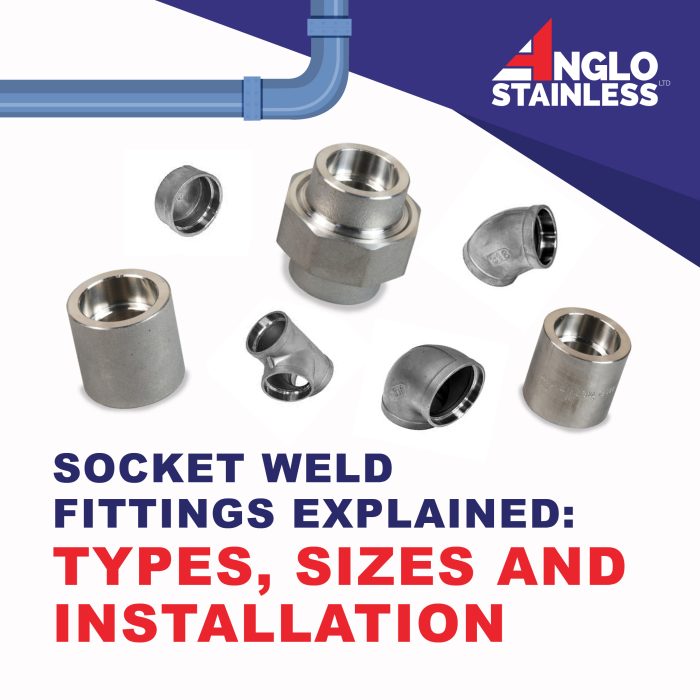
The socket weld fittings range covers every common configuration needed to build out a small bore pipe run:
- SW 45° Elbows, which change pipe direction through 45 degrees
- SW 90° Elbows, which change pipe direction through 90 degrees
- SW Equal Tee, which forms a 90° branch between pipes of the same diameter
- S/W Full Coupling, which joins two lengths of pipe of the same diameter
- S/W Half Coupling, which connects a pipe to a fitting or branch outlet
- S/W Union, a three-piece connector that allows a pipe run to be disconnected without cutting
- SW End Cap, which seals the end of a pipe run
Which combination gets specified usually comes down to the layout of the run itself rather than the pressure class, since most of these types are available across both the 150LB and 3000LB ranges.
How is a socket weld fitting installed?
Getting a socket weld joint right comes down to following the same sequence carefully rather than anything overly technical. A typical installation runs through the following steps:
- Clean the pipe end and the inside of the socket thoroughly, removing any burrs, dirt or rough residue left over from manufacturing that could interfere with the weld
- Insert the pipe into the socket until it makes contact with the shoulder, then withdraw it slightly to leave the expansion gap
- Run a few small holding welds around the joint to keep it in place before the full weld begins
- Weld all the way around the joint, using as many passes as the pipe’s wall thickness calls for
- Check the finished weld by eye and run further checks where the job calls for extra assurance that there are no hidden flaws
A few mistakes come up often enough to be worth flagging directly. Pushing the pipe all the way to the bottom of the socket, leaving no expansion gap, is one of the most common and it’s the kind of error that doesn’t show up as a problem until the system’s been in service and thermal cycling has had time to work on the joint. Inadequate cleaning before welding and a weld that doesn’t run the full way round the joint are the other two issues that turn up most.
Are socket weld fittings stronger than threaded fittings?
Generally, yes. A threaded connection relies on the grip of the screw thread itself to hold pressure and cutting that thread also removes metal from the pipe wall at exactly the point where the connection needs to be strongest. A socket weld joint doesn’t have that weakness, since the weld fuses the pipe and fitting together permanently, which gives it better resistance to both pressure and vibration over time.
Threaded fittings still have a place, particularly on lower pressure systems or where a connection needs to be taken apart without cutting into the pipe and Anglo’s own low pressure and high pressure ranges include BSP and NPT threaded options for exactly those situations. For anything running at higher pressure, exposed to vibration, or needing a permanent joint, socket weld is generally the stronger and more reliable choice.
What industries use socket weld fittings?
Socket weld joints hold up well under vibration and pressure, which is why they turn up across a fairly consistent set of demanding sectors rather than general-purpose plumbing.
Oil, gas and petrochemical settings
In oil, gas and petrochemical settings, pipework often runs at higher pressures and carries hazardous or corrosive fluids, which is exactly where the 3000LB range earns its keep, the same demanding conditions that make pipe flanges in petrochemical industries need a more robust connection than standard process pipework in the first place.
Marine environments
Marine environments present a different challenge, since constant exposure to saltwater makes the rust resistance of 316 and 316L grades a real requirement rather than a nice-to-have. Vibration from onboard machinery and the tight, cramped layout typical of ship pipework both favour a compact, socket-supported joint over one that needs more room to weld properly.
Power generation
Power generation plants push pipework harder than most sectors, with high pressures and extreme temperatures running through steam and water supply systems that need every joint to hold up under constant strain. Water treatment facilities present a steadier but no less demanding case, where high-pressure water and filtration pipelines need the same leak-resistant joint without the risk of rust that a weaker grade would introduce over years of continuous use.
Industrial
Utility and general industrial pipework rounds out the list, where the combination of a leak-resistant joint and straightforward installation makes socket weld the practical default for smaller bore runs that don’t carry the extreme pressures or temperatures of a petrochemical plant. Across all of these settings, the same underlying advantage applies: a joint that resists vibration and pressure well, in a size range where the extra preparation a butt weld demands isn’t always justified
Socket weld vs other fitting types
Socket weld isn’t the only welded joint option and it isn’t always the right one. For higher pressure, a smooth internal bore, or larger diameter pipework, a butt weld fitting is usually the better fit, since the pipe ends are welded directly together rather than one sitting inside the other. The table below covers the practical differences and for a closer look at how cost, installation time and pressure performance stack up between the two, differences between buttweld vs socket weld fittings explained is worth a look before committing to either approach.
| What matters | Socket weld | Butt weld |
| Pipe end preparation | None needed beyond a clean, square cut | Requires bevelling before welding |
| Typical pipe size | Small bore, up to 2″ (DN50) | Any size, including large diameter runs |
| Internal bore | A small step where the pipe meets the socket | Smooth and uninterrupted all the way through |
| Installation time | Faster, since there’s no bevelling or edge prep | Slower, with more preparation and a more skilled weld |
| How the joint is made | Weld runs around the outside of the joint | Pipe ends are welded directly together |
| Best suited to | Vibration-heavy, smaller bore systems | High pressure, high temperature or larger pipe runs |
| Something worth checking | The small internal step can trap residue over time in hygiene-critical systems | Fewer places for residue or moisture to collect |
Common questions about socket weld fittings
How long does it take to install a socket weld fitting?
A single joint typically takes less time than an equivalent butt weld, since there’s no bevelling to do beforehand and the socket itself holds the pipe in position while it’s welded. Exact timing depends on pipe size and the number of passes needed, but the time saved on preparation is one of the main reasons socket weld gets specified on smaller bore runs with tight schedules.
Can a socket weld fitting be reused?
Not once it’s been welded. The joint is permanent, so a fitting that’s already in service can’t be unwelded and reused elsewhere without damaging it. This is different to a threaded fitting or a union, which can be disconnected without cutting into the pipe.
What size socket weld fittings do I need?
Size is driven by the standard size rating of the pipe in your system rather than the fitting itself, since the socket needs to match the outside diameter of the pipe it’s receiving. Anglo’s 150LB and 3000LB ranges both cover ¼” to 2″ (DN8–DN50) and getting the pressure class right matters just as much as the size, since a fitting rated below the system’s operating pressure is a safety issue rather than a minor spec mismatch.
Do socket weld fittings need bevelled pipe ends?
No and this is one of the main practical differences from butt weld. The pipe simply needs a clean, square-cut end to sit correctly in the socket, without the angled edge preparation a butt weld joint requires.
Socket weld fittings earn their place in a pipework system by making smaller bore, higher-vibration applications easier to install without giving up joint strength. Getting the pressure class, size and expansion gap right at the point of installation is what determines whether that joint performs for years rather than needing attention early.
If you’re unsure which pressure class or size suits your application, get in touch with your requirement and the team can help you specify.